
Author:BelightRelease Date:2026-11-23Number of visitors:10
Lead: Most indoor LED walls do not fail because of the panels. They fail because the wall behind them was never checked, the service access was designed after the screen was ordered, and the signal cable run was decided on installation day.
An indoor LED wall is a dead load plus a service load. Before choosing a cabinet, confirm three numbers with the building side: the wall construction (masonry, drywall, steel frame), the permitted load per square metre, and the mounting method the structure allows. A fine-pitch wall is heavier per square metre than a rental panel of the same size, because the cabinet is denser and the power and control hardware sit inside it.
The practical order is: wall capacity → mounting system → cabinet depth → pixel pitch. Choosing the pitch first and discovering the wall cannot take the frame is the most common cause of a delayed handover.
Indoor installations are usually front-service or rear-service, and that decision changes everything: the space behind the wall, whether a maintenance corridor is needed, and how a failed module is replaced without dismantling the screen. In a lobby wall mounted on a finished plasterboard partition, rear service is often impossible — so front-service cabinets, magnetic module removal and a spare-module kit belong in the contract, not in the maintenance budget later.
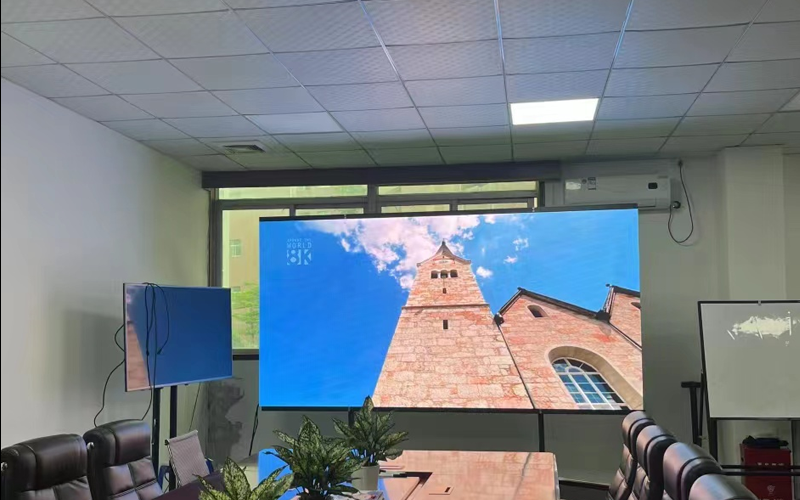
Indoor installation in a meeting room: alignment, viewing height and access determine the mounting frame
| Check | Target | Typical mistake |
|---|---|---|
| Wall load | Cabinet + frame + service load within the permitted value | Only the cabinet weight was quoted |
| Viewing geometry | Bottom edge above seated eye level where required | Screen starts at floor level, front row cannot see the bottom |
| Power circuit | Dedicated circuit, capacity confirmed by the electrical contractor | Shared with HVAC, breaker trips at full white |
| Signal path | Cable route planned, length within the sender's limit | Cable run decided on site, link unstable |
Data note: load, power and cable limits are project-specific; confirm them against the cabinet datasheet and the building's structural and electrical drawings.
Q: How much space is needed behind an indoor LED wall?
A: It depends on the service mode. Rear-service cabinets need a maintenance corridor wide enough to remove a module and reach the power box; front-service cabinets need only the frame depth. Confirm this before the partition is built.
Q: Can the wall be installed on drywall?
A: Only with a properly engineered frame that transfers load to structure, and only within the permitted load. A plasterboard partition alone is rarely adequate for a large wall.
Q: What should be kept as spare parts?
A: At minimum spare modules, one power supply and one receiving card per screen, plus the configuration file. Without the file, a replacement card will not match the original settings.
Shenzhen Belight Technology Co., Ltd.
Tel: +86 0755 23081583 Email: info@belightled.com WhatsApp: +86 18038089950
Address: Shiyan, Baoan District, Shenzhen, China
Send your wall type, viewing distance and room dimensions — we will confirm the cabinet, frame and service mode for the project.
References: IEC 62341 OLED display standards series (IEC, for terminology reference); ANSI/IES recommended practice for display luminance (IES). Load and power values are project-specific and must be confirmed on the cabinet datasheet. Updated: 2026-11-23.
Previous:Outdoor LED Cabinet IP Rating: What IP65 Really Covers and How to Verify It
Next:no more

 +86 0755 23081583

info@belightled.com

Shiyan, Baoan, Shenzhen, China